For Organisations
What happens under the table.
Things get discussed, decided, pushed through. And still, what is really going on often only comes up over coffee. In the corridor. Once the door has closed.
Recognition
Where it chafes, without anyone putting a finger on it.
You can feel it in a team: the tension nobody names, the subject everyone keeps walking around, people who go along without really speaking up, change in the team that hasn’t quite found a place yet. Colleagues working next to each other instead of with each other.
Or perhaps you notice something in yourself. That in a meeting you answer from your role, not from what you really think. That you feel something happening and let it pass, because naming it is complicated. That you are responsible for people and don’t actually know how they are doing. Or they don’t know how you are doing, because you worry what that would do to their picture of you. That costs energy. It leaks away into friction, into awkward collaboration, into people disengaging or dropping out, people doing what is ‘expected’ instead of being rooted in their own strength.
And the difficult part is this: you don’t solve it with another meeting or another process. It isn’t in the structure. It is in what people don’t say to each other.
What can change
The real conversation, out in the room
Think of a team where the real conversation happens in the room.
Where people say what they see, even when it is uncomfortable. And where that doesn’t escalate, but opens something. Where someone dares to name a boundary without apologising for it. Where disagreement is allowed to exist without camps forming. Where people dare to be more themselves at work.
Or think of yourself at the head of that team.
That you no longer have to work out how a manager would respond, but can say what you actually see. That doubt and feeling are allowed without you losing your position. That you sense what is happening under the table in a meeting, and dare to name it. That you bring calm because you are calm, not because you are performing it. Leadership that is given room naturally, because people can feel that it is real.
This is not a vague ideal. It comes about when people learn to feel what is going on in themselves, and learn to bring that in. Clearly and with respect. When people learn how to stay connected, even when it gets uncomfortable. That is what I work towards.
Why with me
I know both worlds
Body-based work in the workplace may raise a question: won’t this be too soft, too vague, too far from what we are actually dealing with?
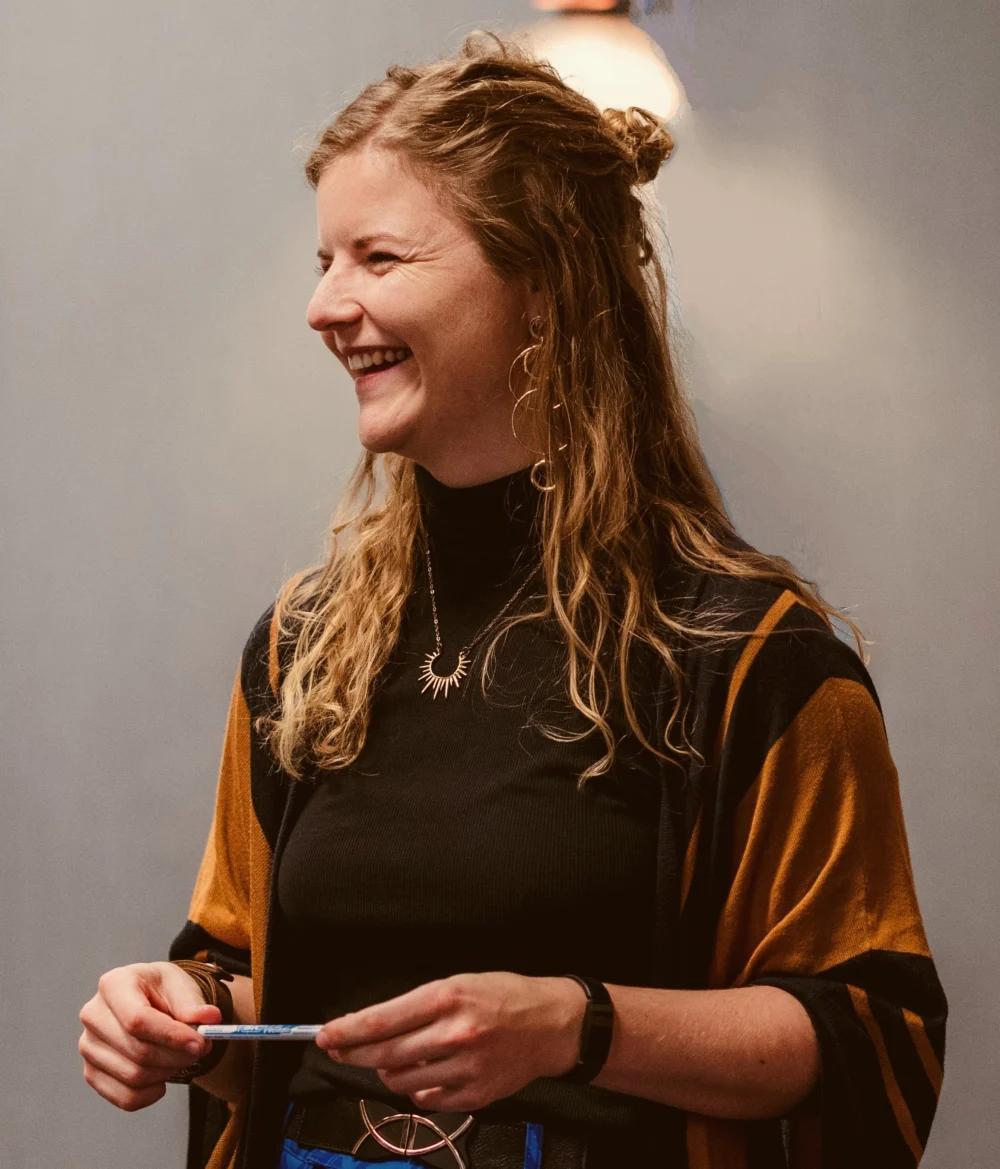
I see it differently. I work as a board adviser, I sit in boardrooms, I think along about strategy, governance and the dynamics between the people who carry an organisation together. And I go deep into body-based work. Those two worlds rarely meet. Because I know both from the inside, I can translate in both directions. I take your people inwards without it becoming vague, and bring back what opens up there in language that lands in your workplace. Thinkers and professionals in particular can feel that, and it is what makes them willing to come along. There is a considered foundation under what I do, not improvisation. But it is never a fixed model I run through regardless of who is in front of me. I keep tuning in to what is alive in the moment, in the person and in the organisation.
Does this belong at work?
You cannot leave half of yourself at the door
There is often a second hesitation: isn’t this too close for the workplace? You would rather keep work and private life apart.
I understand that reflex. And still, whatever is going on in you comes in with you, whether you name it or not. Being allowed to be more of a person at work, being able to bring yourself in properly, is exactly what takes teams further: more connection, more creativity. And even though that is not the aim: when people feel freer and more themselves, the work often starts to flow better by itself. And if you lead, it often starts with you. The more you can be yourself, the less it costs you, and the sooner you see the same thing in your team.
What we can work on together
Three ways in
What we pick up depends on what is going on with you. Broadly, I see three ways in, and they often run into one another.
Stress and wellbeing
A lot of tension is already held in the body before anyone names it. I work with body awareness as the way in: people learn to read their body’s signals again, to make room, to take better care of themselves. Less bottled-up tension, more resilience, and people who speak up sooner rather than dropping out.
Authentic leadership
Leading from who you really are, instead of from a hat, a role or a mask. We look at what drives you, where you hold yourself back, and how you can be present in a way that is true. Leadership that brings calm and direction, because it comes from the inside. So that you can lead more from yourself, from your own strength.
Collaboration and team dynamics
This is where my background comes in: sensing what is going on in a team or a boardroom, and putting the undercurrent into words that nobody else names. From silos to connection, from passing each other by to working with each other. And always concrete: so how do we do that? What do we agree?
How I work
No two programmes are the same
I tune in to what you need. But the way I work is recognisable and consistent. Underneath it lies a broad foundation. From business administration and change management to mindfulness, systemic and body-based work.
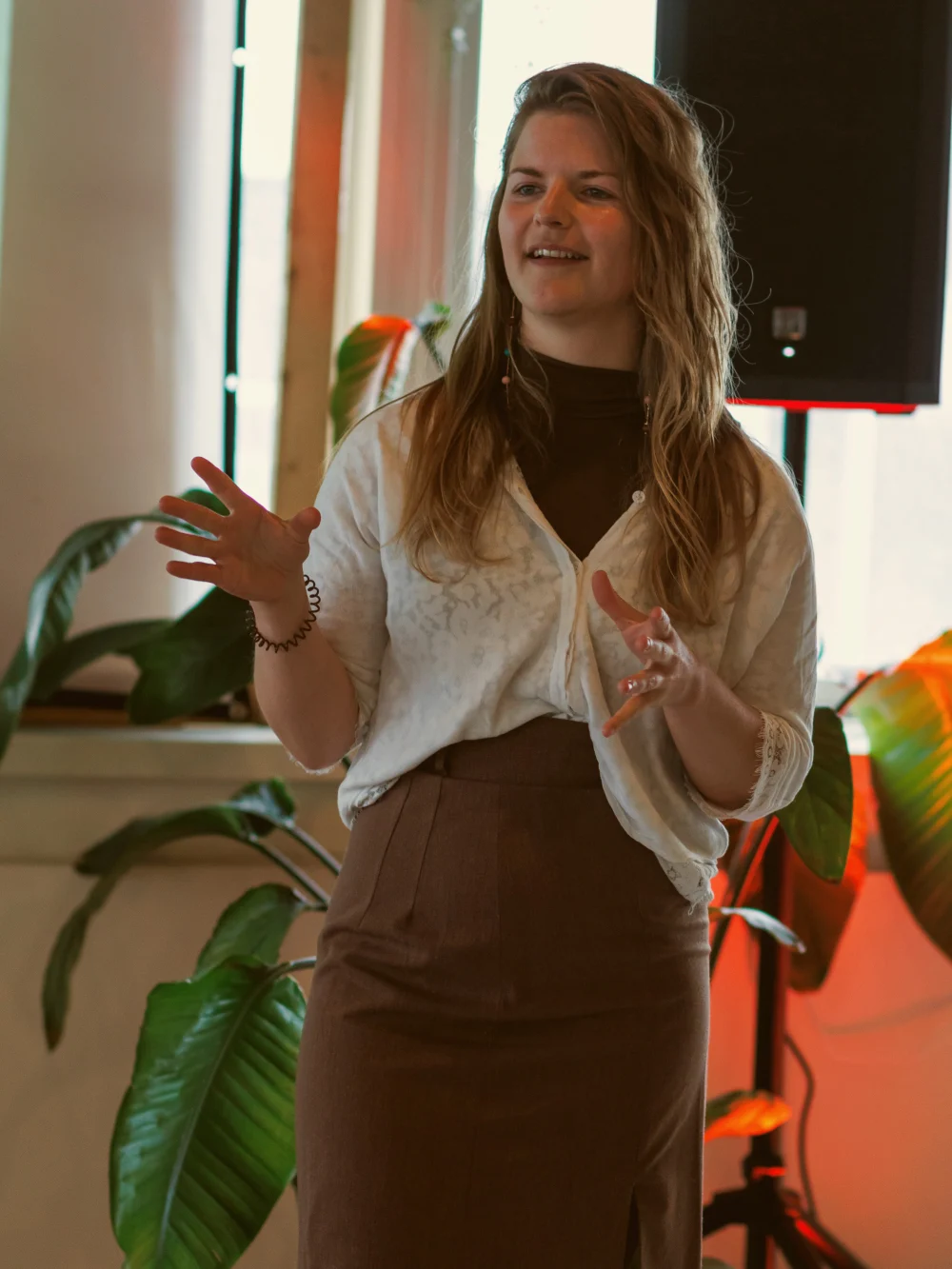
We move between talking and experiencing. The real conversation, with open and sometimes bold questions that others might not ask so readily, so that depth can appear. Alongside that, moments of breath, stillness and care, so people can feel what is happening in them. Where are you, what do you actually think of this? From there people bring themselves in, instead of speaking from a role, a conditioning or an expectation. Each time I bring it back to the person: what is the effect on you? What does this touch? What does it say about your own experiences? That way what is going on comes loose from ‘the other person’ where the friction sits, and we can look without judgement at where it comes from. And then: how does that relate to the way you work together, to your culture, to where you want to go. So that the source becomes visible and another route becomes possible. Sometimes we also work through the body. In your head you can reason endlessly about why something is not that bad, or why you had better keep quiet, and you keep yourself small without noticing. Your body does not play along. What is going on is then allowed to grow for a moment, to be felt, instead of us moving around it. That way you bring all of yourself in, not only the part that is safe.
Safety comes first. There is room, there is pace, and there is choice. Everything is an invitation and nobody has to do anything. That is exactly what lets people open up.
Experiences
What clients say
Els managed to create a safe and trusting atmosphere in which participants felt free to speak up. Afterwards I heard a lot of enthusiastic responses.
Yana Mechielsen · Impactmakers Community · translated from Dutch
It is remarkable to see how much gentleness and respect Els brings to holding a space. I felt completely free to be myself and to express myself.
Vera · translated from Dutch
What it brings
Broadly speaking
What a programme brings exactly depends on your intention and on the people. Broadly, it can be this:
For your people
More rooted in their own strength, daring to speak up from connection instead of reaction, holding their boundaries better, and more calm and flow in the way they work.
For those who lead
Leading from who you are instead of from a role, with the confidence to say what you see and to let what is there exist. Leadership is catching: if you are rooted in your own strength, you give others room to be too.
For teams
An undercurrent that can be talked about instead of running underground, collaboration that connects instead of passing each other by, and difference that gets room without derailing.
For the organisation
Less tension and absence, more enjoyment and resilience at work, and the creativity and results that appear when people feel safe enough to really be there.
What you can choose from
From a half-day to a longer programme
We choose the form that fits the question and the room you want to make for it. A single workshop or half-day, for instance around authentic communication, connection, or reflecting on how you work together. A longer team programme. Or a leadership programme with both team and personal sessions. I also guide individual employees or managers one to one. For someone who has lost themselves or is searching, who is getting stuck and at risk of dropping out, well before it comes to that. Or a manager who wants to find their own voice, and to learn to lead from their own strength instead of from a role.
Investment
Every collaboration is put together with you, shaped by what is going on, the size of it and what is needed. What it costs we discuss clearly and to measure, so you know exactly where you stand. All work with organisations is available in English.
Let’s meet
Every programme starts with an exploratory conversation. A chance to feel whether there is a click, and whether I am the right person for what is going on.